
Community & Quality of Life

People living with Multiple Chemical Sensitivity (MCS) often experience significant challenges that affect their health, daily life, and overall well-being. They are about three times more likely to be in poor health compared to the general population and more likely to face difficulties with everyday activities such as preparing meals, attending medical appointments, shopping, or doing household chores. In fact, only 71–77% of people with MCS report no difficulty with daily activities, compared to over 90% of the general population.
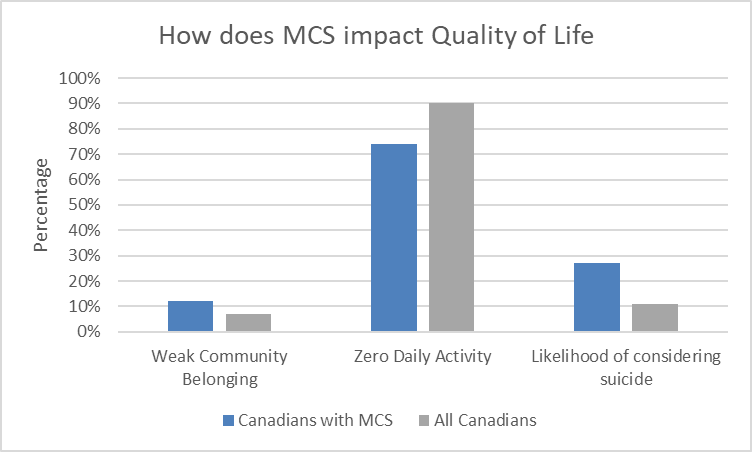
Canadians living with Multiple Chemical Sensitivity (MCS) report lower well-being and social connection than the general population. About 27% have considered suicide, compared to 11% of all Canadians. Only 74% report no difficulty with daily activities, compared to over 90% of others. Additionally, 12% feel a weak sense of community belonging, a figure that is notably higher than the 7% observed in the general population. Data sourced from the Canadian Community Health Survey (CCHS) 2020
Access to appropriate care is also a challenge. People with MCS are 1.5 times more likely to need to consult a medical specialist for a diagnosis and twice as likely to experience difficulties obtaining specialized care compared to others.
These barriers extend beyond health care. People with MCS report lower satisfaction with their housing, with many describing a lack of safe living environments that do not trigger their symptoms. Social and emotional well-being are also affected — 12% report a weak sense of community belonging compared to 7% of the general population, and they report lower emotional security and recognition of competence.

Data sourced from the Canadian Community Health Survey (CCHS) 2020
The cumulative effects of isolation, disbelief, and lack of support take a severe emotional toll, sometimes pushing individuals toward thoughts of hopelessness. About 27% of people with MCS have considered suicide, more than double the rate of the general population (11%).
Together, these findings paint a clear picture of the broader challenges faced by people with MCS — not only in managing their health but also in achieving safety, stability, and a sense of inclusion in their communities.